

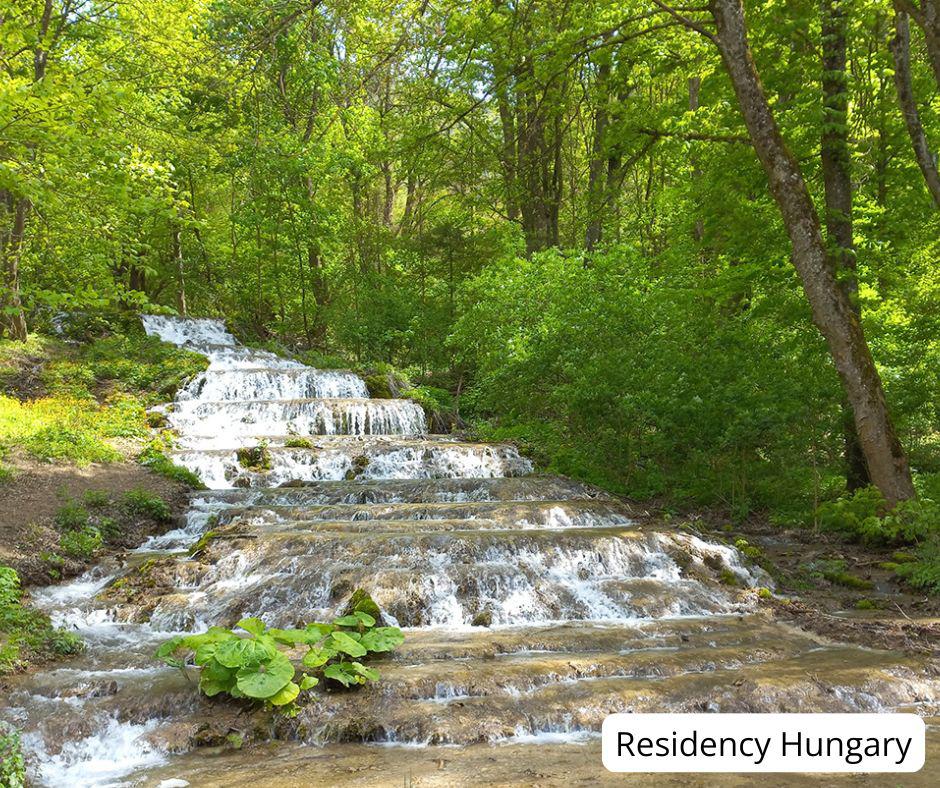
The Szalajka Valley enduring popularity lies in a rare combination: breathtaking scenery, easy access, excellent infrastructure, a charming forest railway, and a wide range of family-friendly experiences - all complemented by inviting places to eat, relax, and explore.
The valley’s story begins with its historic forest railway, first built in 1908. While the original network once spanned over 30 kilometers, today a beautifully preserved 4-kilometer section remains. A gentle, nostalgic 15-minute ride carries visitors through the forest to the peaceful Gloriett Clearing. From here, the journey continues on foot.
Marked by the green trail, the path winds alongside the Szalajka Stream, its clear waters weaving through alder-lined banks. The route gradually reveals the valley’s many layers: the quiet opening of the Tótfalusi Valley, the nearby wildlife park, and the occasional crossing of the railway line. Along the way, the Aladár Zilahy Forestry Museum offers a glimpse into the region’s past, where tools, models, and archival materials tell the story of forest life and labor across centuries.
Further ahead, beneath a beautifully carved Székely gate, stands the Guardian of the Carpathians - a wooden statue erected in 2002, inspired by a monument lost in 1918. Facing toward the Large Lake, it quietly watches over the valley. Circling the lake leads to the trout farm, established in 1957 on the site of traditional fish breeding. It remains one of the valley’s most distinctive and enduring features.
Nearby, a meadow opens to reveal traces of the past: from 1802, this area was home to an early iron smelter. Above it, partially hidden in the hillside, stands the former Villa Negra, now welcoming guests as the Fátyol Guesthouse. Crossing the stream once more and climbing a gentle slope, you arrive at the Small Lake, once vital to the smelter’s operation. Opposite, the Rock Spring offers a subtle natural curiosity: its water is slightly warmer than nearby sources, the result of underground currents mixing cold karst water with deeper, naturally warmed flows.
A short walk further reveals the highlight of Szalajka Valley: the Fátyol Waterfall.
No two visits are the same. In every season, the waterfall offers a different face: soft and shimmering in spring, lush in summer, golden in autumn, and quietly frozen in winter. Today, it serves as both a peaceful resting point and the final stop of the forest railway. From here, you can linger a little longer in nature or simply hop on the train and enjoy the ride back.