

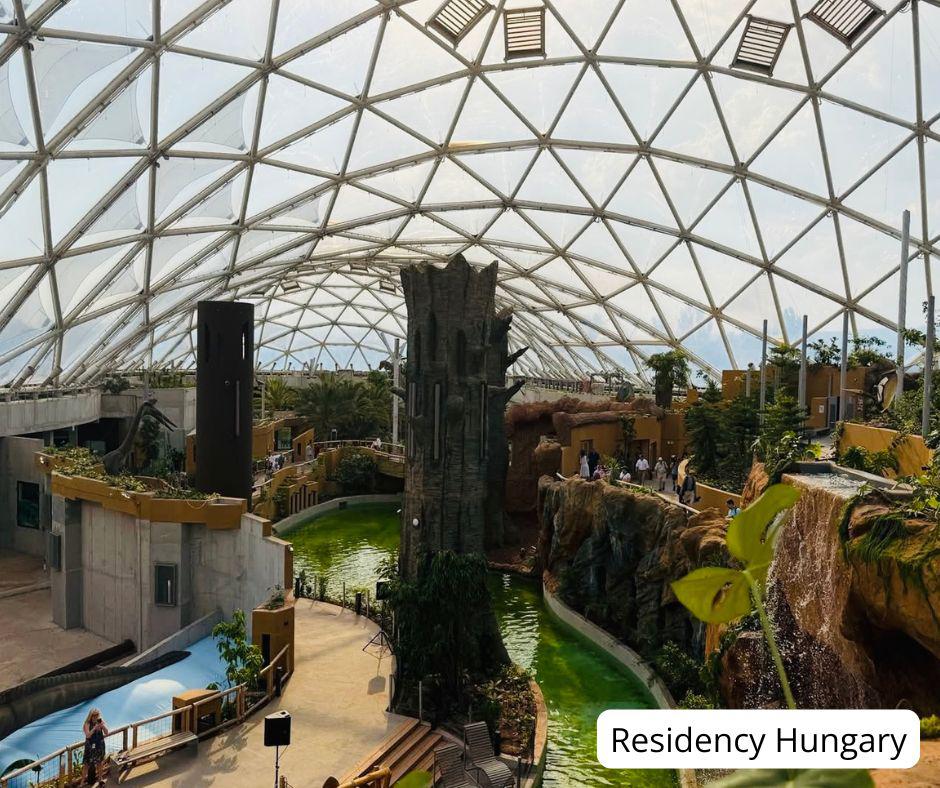
Set within a lush tropical landscape, it invites guests to discover rare wildlife, towering prehistoric creatures, spectacular installations, cascading waterfalls, and a rich programme of interactive experiences - all in a tranquil setting designed to bring a slice of the rainforest to the heart of Budapest.
Among the Biodome's most remarkable residents are Hanuman langurs, Bali mynas, peacock-pheasants, and Luzon cloud rats. One of the biggest highlights is the Hanuman langur, a primate native to South Asia whose wild populations have been steadily declining. To help safeguard the species, the European Association of Zoos and Aquaria coordinates an international conservation breeding programme, and the Biodome's langurs arrived in Budapest as part of this initiative.
The species also has a literary connection: Hanuman langurs appear in Rudyard Kipling's classic The Jungle Book. Their arrival marks the first time in 74 years that visitors to Budapest Zoo have been able to see these remarkable primates.
Another welcome return is the Bali myna, one of the world's rarest birds. Back at the Zoo after an absence of 15 years, the species is classified as critically endangered, with fewer than 50 individuals believed to remain in the wild.
Nearly one-third of the Biodome's visitor area is covered with lush vegetation, with a total planted surface of 2,950 square metres. Creating this indoor rainforest required an enormous horticultural effort. During construction, 150 planting beds were installed and filled with 276 cubic metres of foamed glass drainage material and 1,740 cubic metres of specially formulated tropical growing medium - enough to fill around 70 articulated lorries with semi-trailers.
The result is a vibrant, immersive environment that combines wildlife conservation, botanical diversity, and prehistoric discovery in one extraordinary indoor destination.
The Biodome operates as a standalone attraction within the Budapest Zoo and Botanical Garden, making it a natural extension of a visit to the zoo.
The goal was to create a unique experiential space that offers relaxation, nature-based experiences, and educational programs for all age groups.